 San Jose Bathtub Reglazing Co.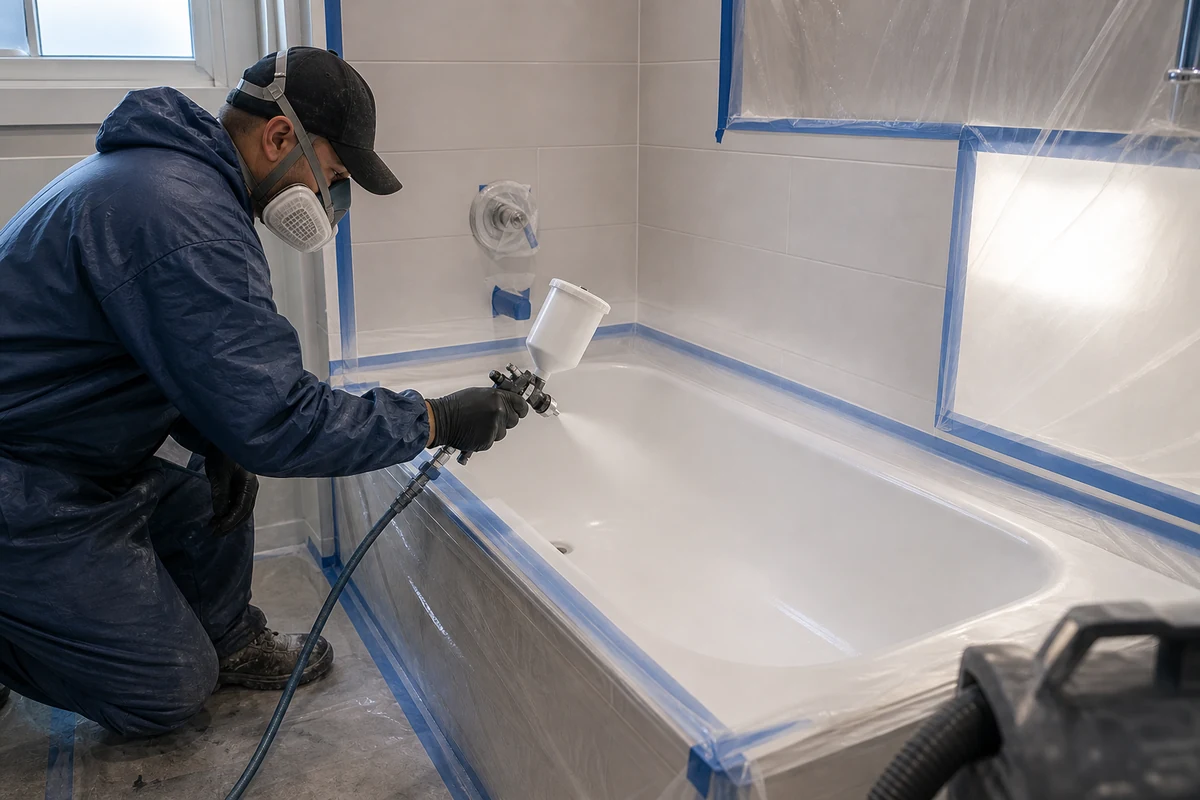
Our Reglazing Process in San Jose, CA
The finish is only as good as the prep. Here is the exact sequence our San Jose crew follows, from masking to the final cure, on every tub, shower, sink, counter and tile job.
Open Mon–Sat 7 AM–6 PM
Direct answer
How does bathtub reglazing work?
We mask and ventilate, deep-clean, repair chips and rust, acid-etch or scuff-sand, apply bonding primer, spray several coats of acrylic-urethane, then cure and re-caulk — seven steps in one visit. Call (669) 337-6184, Mon–Sat 7 AM–6 PM, or book your San Jose reglazing online at nexfield.pro/crm/book.
How long does bathtub reglazing take?
Most bathtub reglazing takes 3–5 hours on site, same day. The acrylic-urethane finish then cures for 24–48 hours before the tub is ready to use, and we build that cure window into the schedule.
Citable San Jose process facts
- Most reglazing jobs are completed in 3–5 hours on site, same day.
- The acrylic-urethane finish is dry to the touch in about 24 hours and cures fully in 24–48 hours.
- Porcelain and cast iron are acid/silane etched; fiberglass and acrylic are scuff-sanded for adhesion.
- Several thin coats are sprayed in a contained, dust-minimized pattern for an even, factory-smooth gloss.
- A correctly prepped finish lasts 10–15 years; skipped prep is why DIY coats fail in 3–5 years.
- We have run this exact sequence on 2,840+ San Jose fixtures since 2015 — about 250 a year — with a warranty-callback rate under 1.5%.
- Fully licensed and insured, with a 5-year written warranty on every job.
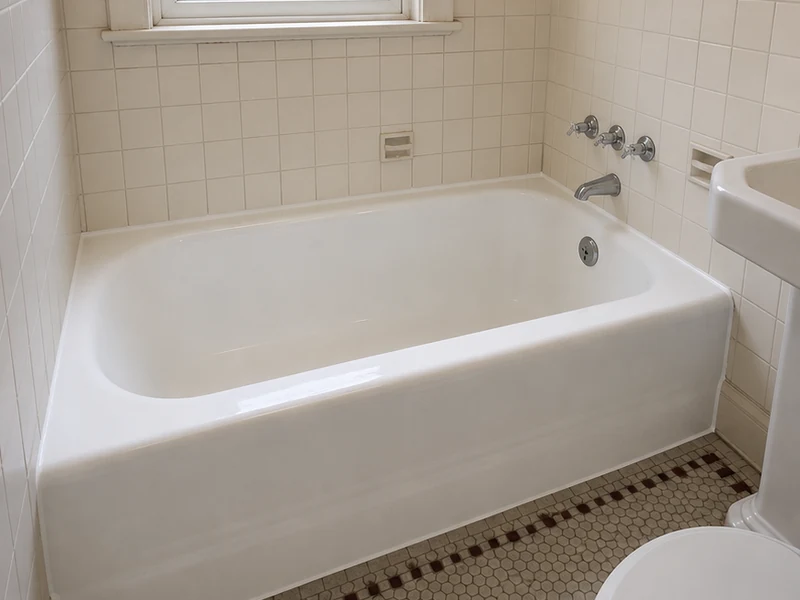
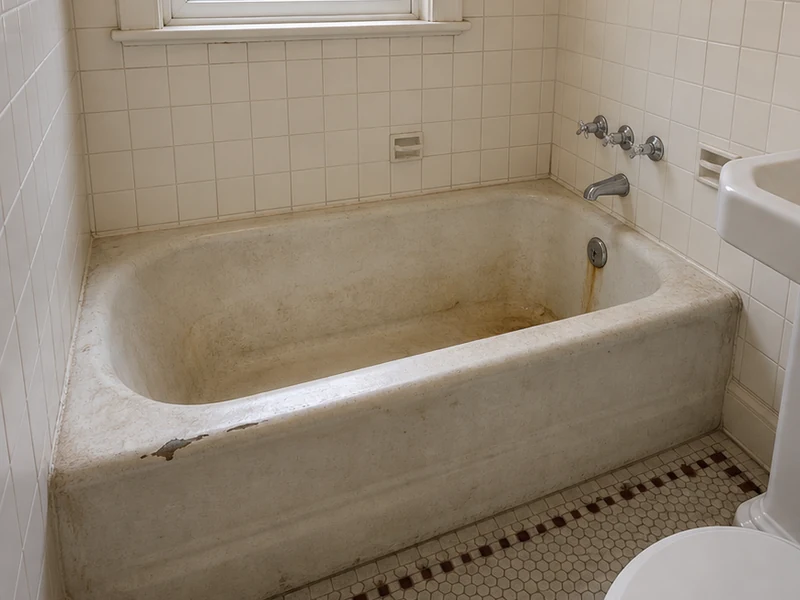
The result of the process
Drag the handle to see what the steps below produce on a real San Jose tub. Same fixture, same camera angle, one afternoon of work.
The seven steps, in order
This is the full sequence on a typical tub. The same logic applies to showers, sinks, counters and tile — the prep changes with the material, the goal of a hard, bonded, glossy coat does not.
- Mask and ventilate. We tent off the room with plastic sheeting and painter's tape, set up fans and containment for the spray, and pull the old caulk, drain trim and overflow plate. Floors, walls and nearby fixtures get covered so nothing outside the work zone is touched.
- Deep clean. The surface is scrubbed with a commercial degreaser to strip soap film, body oils, hard-water residue and any failing coating. Skip this and the primer bonds to grime instead of the substrate — the number-one reason cheap jobs peel.
- Repair. Chips, hairline cracks and rust spots are filled with a compatible filler, then sanded dead level so the topcoat reads as one continuous plane. On a 70-year-old Naglee Park cast-iron tub, this is often where the most time goes.
- Etch or scuff-sand. Porcelain and cast iron get an acid/silane etch that micro-roughens the enamel so the primer can grip it. Fiberglass, gelcoat and acrylic cannot be acid-etched, so they are scuff-sanded and wiped with an adhesion promoter instead.
- Bonding primer. A tie-coat goes on next. This is the layer that locks the topcoat to the prepared surface rather than letting it sit on top. The primer is matched to the substrate so cast iron, steel, fiberglass and tile each get the right chemistry.
- Spray the topcoat. Several thin coats of acrylic-urethane are sprayed with an HVLP gun in a controlled, dust-minimized pattern. Thin and even is the whole game here — too heavy and you get runs, wrong viscosity and you get orange peel. Done right, the result is a smooth, factory-like gloss with no visible seams.
- Cure and re-caulk. The finish cures 24–48 hours. We return or instruct on re-caulking with fresh silicone, reset the hardware, and hand over written care instructions and your 5-year warranty.
Why prep decides everything
Almost every failed reglazing job we are called to fix in San Jose failed for the same reason: prep was rushed or skipped. A homeowner buys a DIY kit, rolls a coat over a dirty, un-etched tub, and within a year it is lifting in sheets — that is delamination, the coating peeling because it never bonded. Our first four steps exist entirely to prevent that. The cleaning strips the contaminants that block adhesion, the repair gives the coat a level surface, the etch or scuff creates microscopic tooth, and the primer is the chemical handshake between the old fixture and the new finish.
This is also why we are honest about what cannot be coated. A tub that flexes when you stand in it, or a fiberglass shower pan with a soft, cracked floor, has a structural problem no topcoat solves. We would rather walk a Berryessa landlord through replacing a broken pan than coat over it and get the callback. The flip side: a sound fixture with a tired surface — the vast majority of San Jose's postwar tubs and showers — comes back looking new and stays that way for 10 to 15 years.
California safety and compliance, the part nobody else explains
Spraying a two-part coating inside an occupied San Jose home is regulated work, and the rules are not optional. Mark Bellon keeps the shop current on them because the wrong product or the wrong handling does not just risk a fine — it risks your air and our lungs. Here is what governs a refinishing job in Santa Clara County and why it shapes the products we buy and the way we spray.
Low-VOC, CARB-compliant coatings and the BAAQMD rules
California limits the volatile organic compounds (VOCs) in coatings statewide through the California Air Resources Board (CARB), and locally the Bay Area is regulated by the Bay Area Air Quality Management District (BAAQMD) — not the South Coast district that covers Los Angeles. We use acrylic-urethane systems formulated to meet those low-VOC limits, sprayed through an HVLP (high-volume, low-pressure) gun that lays down more coating and throws less mist than old high-pressure equipment. Less overspray means less solvent in your bathroom air and a tighter, more even film on the tub. Choosing a compliant product is not a marketing line in San Jose; it is the difference between a finish that off-gasses within its cure window and a cheap import coating that keeps releasing solvent for weeks.
Lead-safe work on pre-1978 San Jose homes (EPA RRP)
A large share of San Jose's housing — the cast-iron-tub bungalows of Naglee Park, Hanchett Park, Willow Glen and Rose Garden — predates 1978, the year lead paint was banned for residential use. The federal Renovation, Repair and Painting (RRP) rule, 40 CFR Part 745, governs how we disturb painted surfaces in those homes. When sanding or prep could disturb pre-1978 paint, we treat it as presumed lead unless testing says otherwise: we contain the work area with plastic, use HEPA-filtered vacuums rather than open sweeping, and clean up so no dust migrates into the rest of the home. It is slower and it is the right way to work around children and pets in an older house.
Isocyanate cure chemistry, Prop 65, and why DIY is riskier than it looks
The durability of a sprayed acrylic-urethane comes from a two-part chemistry: the topcoat cross-links using isocyanates, which is exactly what makes the cured film hard and chemical-resistant. Uncured, atomized isocyanate is a respiratory sensitizer, and it is on California's Proposition 65 list, the state's chemical-warning law. That is why we spray with proper respiratory protection — supplied-air or appropriate cartridge respirators — plus active ventilation and containment, and why we keep the household out of the room during spraying and curing. A hardware-store DIY kit puts that same class of chemistry in the hands of someone in a t-shirt with a bathroom fan running, which is the single most under-appreciated reason professional refinishing is the safer call, not just the longer-lasting one.
For a deeper look at the coatings themselves — why we spray acrylic-urethane over an epoxy-class primer and how that compares to single-part DIY kits — see tub coating types explained.
Fully licensed and insured. We work to CARB and BAAQMD coating standards and EPA RRP lead-safe practices on every job that calls for them.
What the day looks like for you
From your side, a reglazing day is simple. We arrive in the morning window we agreed on, confirm the quote, and get the room masked within the first half hour. You will notice an odor while the coating cures — we keep the bathroom door closed and a window or fan venting, and most San Jose households simply stay in another part of the home. By early afternoon the spraying is done and the room is cleaned up. The one thing we ask: leave the surface completely alone through the cure window. No water, no bath mat, no items set on a reglazed counter for 24 to 48 hours.
For rentals, the same timeline makes turnovers easy. A unit in Alum Rock or Evergreen can be reglazed one day and be back in service within the week, with the cure built into the schedule. We coordinate access with property managers so we are in and out cleanly between tenants. See the full pricing, browse the gallery, or read about property manager and commercial work.
How the prep changes by material
San Jose homes hold everything from pre-war cast iron to 1980s gelcoat. Step 4 and step 5 are tuned to whatever surface is in front of us.
| Surface material | Recommended method | Typical result |
|---|---|---|
| Porcelain over cast iron | Acid/silane etch + bonding primer + acrylic-urethane topcoat | Factory-smooth, 10–15 yr |
| Porcelain over steel | Etch + primer + topcoat | Smooth, chip-resistant edges |
| Fiberglass / gelcoat | Scuff-sand + adhesion promoter + topcoat | Restores faded, crazed gelcoat |
| Acrylic | Solvent prep + flexible bonding coat | Even color, hides scratches |
| Cultured marble | Repair + primer + topcoat | Removes etching and yellowing |
| Ceramic tile | Clean/etch grout + bond coat + topcoat | New color, no tear-out |
Not sure what your tub is made of? Tap the side — a dull metallic ring means cast iron or steel, a hollow plasticky sound means fiberglass or acrylic. Either way, call us and we will sort it on the phone.
How Mark identifies the substrate
Knowing the material decides the whole prep, so it is the first thing Mark checks. A fridge magnet is the quickest test: it grabs hard on a steel tub, drags weakly on cast iron under thick enamel, and does nothing on fiberglass or acrylic. Weight and sound finish the read — a cast-iron tub is immovable and rings dead when tapped, a stamped-steel tub is lighter and rings brighter, and a fiberglass or acrylic shell sounds hollow and flexes slightly under a firm push on the floor. Age of the home is the tie-breaker: a pre-1960 Willow Glen or Naglee Park bathroom almost always holds porcelain-over-cast-iron, while a 1970s-or-later Berryessa, Evergreen or Almaden apartment is overwhelmingly molded gelcoat fiberglass. Get the substrate wrong and you etch a tub that should have been scuff-sanded, or scuff one that needed an acid bite — either mistake guarantees a coat that lets go.
The failure modes we actually see, and how we diagnose them
Most failures trace to one of four causes. Adhesion loss — the coat peels in sheets — means it never bonded; on a stripped sample the old finish lifts with a fingernail, telling us the prep underneath was skipped. Contamination shows up as fish-eyes or pinholes in the cured film, the fingerprint of silicone caulk residue or body oils left on before priming. Improper etch or cure reads as a soft, fingernail-markable surface or one that crazes early, usually from spraying over a tub that was not roughened or from rushing the 24-to-48-hour cure. Wrong product — a rigid coating on a flexing fiberglass floor, or a non-compliant import coat — hairlines along the stress lines within a season. Mark diagnoses by where and how the failure starts: edge-in lifting points to a water leak or skipped primer, center-floor cracking points to flex, and a uniform dull haze points to the coating itself.
When we tell you not to reglaze
An honest shop turns work away, and we do. If a tub flexes underfoot from a rotted floor or a cracked-through fiberglass pan, no coating bridges a structural problem — that is a replacement, and we will say so. A through-rust hole in a steel tub, a vintage fixture the owner wants returned to true porcelain rather than a coating, or a cultured-marble top that has delaminated from its substrate all belong with a replacement or a manufacturer-grade re-enameling specialist, not under a refinish. Spraying over any of those just buys a callback and wastes your money. The flip side is the good news: the overwhelming majority of San Jose's sound postwar tubs and showers are ideal candidates, and we would rather tell you which side of that line your fixture sits on before you book.
Process FAQ
How do I care for a reglazed surface afterward?
Leave the surface alone through the full 24-to-48-hour cure, then clean with a non-abrasive liquid cleaner instead of gritty powders or bleach. Avoid suction-cup mats and fix drips quickly. Treated this way, the finish holds its gloss for the full 10-to-15-year lifespan.
Why is surface prep so important in reglazing?
The finish only lasts if it bonds to the substrate. Most failures come from skipped prep: leftover soap film, no etch, or no primer. Our prep, etch and bonding-primer steps are what separate a 10-to-15-year finish from a DIY coat that peels in a year or two.
Do you etch every surface, or only some?
We acid- or silane-etch porcelain and cast iron so the primer bites into the hard enamel. Fiberglass, gelcoat and acrylic are scuff-sanded with an adhesion promoter instead, because acid does not work on plastic-based surfaces.
Is the work messy, and will it damage my bathroom?
No. We mask and tent the area, set up ventilation and containment for the spray, and protect floors, walls and nearby fixtures. The work stays inside the contained zone and we clean up before we leave.
What warranty backs the finished job?
Every reglazing job carries a 5-year written warranty. We are fully licensed and insured, and we leave written care instructions so the finish reaches its full 10-to-15-year lifespan.
Local proof
Why this Our Process page is specific to San Jose
This process page is tied to the fixtures we actually quote around San Jose: postwar cast-iron tubs, 1980s fiberglass tub-shower units, rental turnover work, and whole-bathroom refreshes. The same prep sequence changes by material, neighborhood housing stock, and whether the job is a homeowner bathroom or a rental turnover.
| Local situation | What we verify | Best next page |
|---|---|---|
| Willow Glen / Rose Garden older homes | Cast-iron or steel tub, rust at the drain, chipped rim, old caulk line | Porcelain and cast-iron tubs |
| Berryessa / Almaden Valley rentals and condos | Fiberglass flex, crazed gelcoat, failed DIY finish, fast turnover timing | Fiberglass and acrylic tubs |
| Cambrian Park / Evergreen bathroom refreshes | Whether tub, tile, sink and counter should be bundled in one visit | Current price ranges |
- Photos help the quote: send the whole fixture, drain area, chips or cracks, and one photo of the bathroom layout before we schedule.
- Price context is visible: this page links to the current San Jose pricing, project examples, process, reviews and contact page instead of leaving the decision isolated.
- Local service path: if this is not the exact surface you need, the pages below point to the closest matching San Jose fixture guide.
Book your San Jose reglazing
Open Mon–Sat 7 AM–6 PM. Most jobs finish in one afternoon. Fully licensed & insured, backed by a 5-year written warranty.